
New 'Got Milk?' Ad Uses Third Stooge to Fight Osteoporosis

Sticks and stones may break their bones, but thanks to a new marketing campaign, the Three Stooges' bones won't break as easily in new advertising from dairy industry's "got milk?" campaign.
Using images from the violently slapstick comedy team, the Three
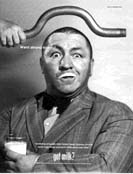
Stooges--one of the longest-running comedy series in movie and television history--one stooge, Curly Howard, appears in a new milk ad debuting in the October issue of Rolling Stone magazine. Curly will let Americans know drinking at least three glasses of milk a day can help keep bones strong and help prevent osteoporosis. Often called the
"brittle bone disease" or "silent disease" because bone loss occurs without symptoms, osteoporosis is a major public health threat for many Americans.
The new ad shows Curly after being hit over the head with a crowbar, and ad copy: Want strong bones? Drinking enough milk helps keep bones strong and may help prevent osteoporosis later.
The ad debuts at a critical time in the fight against osteoporosis, according to Kurt Graetzer, CEO of the Milk Processor Education Program.
"Right now, we have a calcium crisis occurring in our country," said Graetzer. "Osteoporosis affects 28 million Americans and one in five of those affected is male. Most people don't get enough calcium and aren't protecting their bones. Curly's new ad is designed to inform people that milk is an excellent source of calcium and vitamin D."
The National Academy of Sciences recommends adults consume 1,000 mg of calcium a day, the equivalent of about three 8-oz glasses of milk. The average American reportedly consumes--less than one glass of milk a day.
The 'got milk?' Milk Mustache marketing campaign is jointly funded by the nation's fluid milk processors and America's dairy farmers, and is initiated to educate consumers and correct misconceptions about milk. The campaign is licensed by Dairy Management Inc., which, along with state, regional and international organizations manage the American Dairy Association, the National Dairy Council and the U.S. Dairy Export Council.
For more information, visit www.whymilk.com or call 1-800-WHY-MILK.
Edited by Bob Sperber