
LOL's Dairyman's Division: Marrying Tradition and Technology
By Gerry Clark
Wrestling with narrow profit opportunities isn't novel for the dairy industry, but if sheer volume counts for anything, Land O'Lakes Inc.'s Dairyman's Division is sitting high on the mountain and wielding a will for widening those characteristically slim margins. The Tulare, CA-based mega plant, which merged with LOL roughly a year ago, boasts the single largest milk processing rate in the nation (and perhaps the world) at 12.5 million pounds of milk daily.
The 550-employee facility's product roster includes cheese, butter, nonfat dry milk and even fluid milk. Even though the plant traces its origins back to the earliest years of the last century when it was created by the Dairyman's Co-operative Creamery Assn. (the owners up until last year's LOL merger) and its leaders remain proud of the past, they pride themselves not only on emphasizing current know-how but blazing a techno trail.
"Even though the co-op has been here since 1909, we've tried to be state-of-the-art because the margins are so slim," Pat Fischer, director of manufacturing for the facility, told DairyNetwork.com and other members of the dairy community during a tour of the site Thursday. "The building itself might be old, but the equipment will be new."
And for Land O'Lakes in particular, which in late February announced its earnings had plummeted almost 69% for FY 1999, dropping to $21.4 million vs. $68.6 million the previous year, the mandate is on maximizing margins. Executives have blamed the roughly $47 million free-fall on "dramatic declines" in butter and cheese prices as well as a "continued slump" in swine and plant food prices. (See related article).
The lackluster results translate to changes at Dairyman's Division, in addition to a company-wide directive for profit growth.
"Obviously, every company has goals for the next year and we have set goals for this year," Fischer told DairyNetwork.com. "Basically, it's fine-tuning, which is a continuous process. Simply because the margins in dairy are so small, you have to improve what you're doing."
Butter currently represents a strong seller for the site, Fischer said, adding that the plant is processing more of the stuff this time of year than is usually the case. At 125 million pounds of butter produced annually, the plant supplies one-third of all butter in California. "It's been a long time since we've gone to the government with butter," he said. "Butter sales have been very strong."
For 17 years prior to linking with LOL, Dairyman's was making butter for the Arden Hills, MN-based co-op, and had been honored with LOL Master Butter Maker awards for 1995, 1997 and 1998.
"Production is up, prices are low," he said of dairy in general, but predicting that "something will give somewhere" in the future.
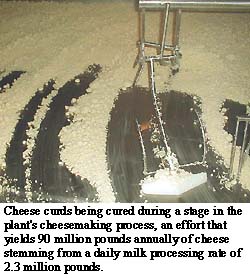
This year, the Dairyman's plant will yield 250 million pounds of dairy product with 90 million of those being cheese. Plus, the site's drying processes supply it with a sort of self-sufficiency, at least when it comes to H2O. With 700,000 gallons of water generated daily through the evaporation process, Dairyman's can self-supply nearly all its water needs even for use in final rinses. It was the first California plant (beginning in 1992) state authorities permitted to use "cow water" (the water being evaporated) for processing functions.
Dairyman's places 180,000-lb of whole milk per hour into separators, yielding 15,000-lb of nonfat dry milk powder every 60 minutes. The site yields approximately 30% of the state's nonfat dry milk.
Plant managers aren't shy in boasting they were there first when it comes to utilizing certain cheesemaking technology that's now become de rigeur. Take the facility's approach to cheese, for example. The starter room in the cheese plant (which incidentally cranks out 2.3 million pounds of finished product daily) is HEPA-filtered and experiences 17 air changes every hour. And that's been the case since 1979.
"It's an example of things we did 20 years ago that are now being done in most cheese plants," Fischer said.
An infrared analyzer used prior to the recombination phase has run more than 9 million samples since 1993. Total duration from the time the milk hits the vat until the cheese goes in the box is roughly nine to 10 hours, a process of which Fischer is particularly fond despite (or rather because of) its idiosyncracies.
"Cheese is a very organic product," he said. "It's constantly changing. Our desire is to make a consistent product, but the fact that you're dealing with a living organism (bacteria) can surprise you a little. Ideally, you have the same amount of bacteria in each cheese vat. Ideally, they're going to perform the same, but due to changes in the milk and environment, that doesn't happen everyday. But it's a fun process."
The site accounts for roughly 12% of California's entire Cheddar and Monterey Jack production. Other cheese types (offered in 640-lb block and 500-lb barrel sizes) include Colby, mozzarella, and reduced-fat versions of Cheddar and Monterey Jack. It devotes 2.3 million pounds of milk processed daily to its cheese efforts.
The plant's semi-arid, verging-on-desert climate conditions offer it advantages over its Midwestern counterparts, Fischer explained. Milk trucks can unload 6,500 gallons in 17 minutes outdoors, with only one cleaning required every 24 hours. Since rains are infrequent, insects don't pose much of a problem, allowing the outdoor unloading.
"We don't have near the issues the Midwest has," Fischer said.
The trucks, driven by LOL employees, conduct six to eight pickups daily, with 80% of the plant's milk sources being within 30 miles. The remaining 20% originates from sites within 50 miles.
Plant leaders also place a high premium on sanitation. The hairnet and foot sanitizers are no different than a multitude of other dairy plants, but how many insist on one-time pallet use to prevent contamination? Dairyman's purchases its pallets new, refusing to recycle them.
"When using previously used pallets, you don't know where the wood in them has been," Fischer explained. "We buy brand-new pallets, put our product on it and ship it out."
The plant largely eludes the special requirements the state of California enforces for adding milk solids (and subsequently calcium and protein levels) in milk that are stricter than federal standards. But since it does send some fluid milk to the Los Angeles market, it ups the solids content by adding condensed milk.
Some 30 million lbs. of the plant's product are earmarked for the powerful Land O'Lakes brand, but the facility also produces products for nearly 20 other brands, including Alta Dena, Tillamook, McDonald's, Albertson's/Janet Lee and Safeway/Lucerne. Speaking of brands, when Dairyman's realized it didn't need to use one of the plant buildings, it leased it out to Yoplait, which processes 700,000-lb of milk per day using LOL employees but retaining the yogurt maker's management.
For the Dairyman's Division, today seems a pivotal point as leaders recognize the plant's past accomplishments, but realize the dynamic is changing for the days ahead.
"Basically, butter and powder have been our history," Fischer said. "Now, with LOL, we're diversifying, and cheese and whey protein are going to be our future."